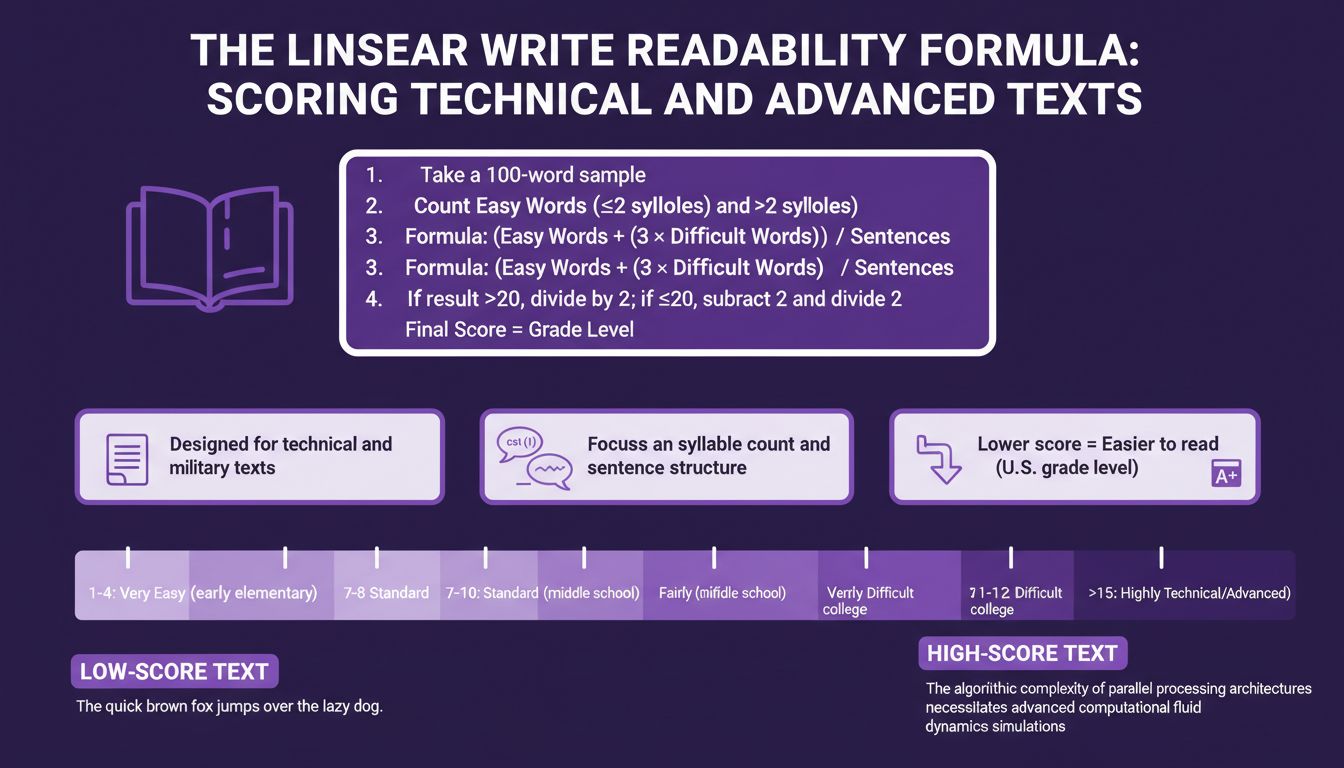
A Formula for Technical Clarity
Linsear Write is a readability formula that measures the readability of English texts, with a particular strength in assessing technical and advanced materials. Created by John O'Hayre for the U.S. Air Force, the formula was designed to score and grade technical texts, ensuring that staff could easily understand complex documentation.
Unlike other formulas that rely primarily on sentence length and word length, O'Hayre took a different approach. He focused on syntax and word complexity, specifically examining syllables in words. His philosophy was simple: words with fewer than 3 syllables are those most adults can understand, while words with 3 or more syllables require a higher level of vocabulary.
The Origins of Linsear Write
John O'Hayre introduced Linsear Write in his book "Gobbledygook Has Gotta Go" while he was employed at the Bureau of Land Management's Western Information Office. His formula differs from other readability measures because, as O'Hayre explained: "Rather than counting every syllable or only words of three syllables or more, we concentrate on words which make up nearly three-fourths of plain English, the words most natural to the language, especially its native nouns and verbs, its one-syllable words."
This focus on one-syllable words reflects O'Hayre's commitment to plain English writing—the idea that clear communication comes from using simple, direct language that readers can easily process.
The Original Linsear Write Formula
The original formula uses a straightforward point system based on a 100-word sample:
- Count a 100-word sample from your text
- Count one-syllable words (excluding "the," "is," "are," "was," and "were"). Each one-syllable word counts as 1 point.
- Count the number of sentences in the 100-word sample. Each sentence (ending with a period or semicolon) counts as 3 points.
- Calculate the reading level: Add the points from the one-syllable words and the points from the sentences to get the total score.
O'Hayre had writers ignore "the," "is," "are," "was," and "were" because, as he explained: "these verbs are so often used to form the weak passive voice, our formula 'emphasizes them out,' and the writer is forced into using stronger verbs." This design choice encourages active voice and stronger, more direct writing.
Example Calculation
Let's walk through an example calculation:
Imagine a 100-word sample with the following counts:
- Number of one-syllable words (excluding "the," "is," "are," "was," and "were"): 55
- Number of sentences: 5
Count points for one-syllable words:
55 one-syllable words × 1 point each = 55 points
Count points for sentences:
5 sentences × 3 points each = 15 points
Calculate the total score:
Total score = 55 (from one-syllable words) + 15 (from sentences) = 70
John O'Hayre's Reading Scale
O'Hayre used a simple reading scale to interpret scores:
- 70 to 80 points: Suitable for the average adult reader
- 80 points: Ideal readability
- Over 85 points: May be too simple
- Below 70 points: Too complex unless aimed at a specialized field
As O'Hayre explained: "If you tally between 70 and 80 points, you are in the right bracket for the average adult reader. A score of 80 is close to ideal, but if you score over 85 you may be getting too simple; if you drop much below 70, you're too complicated unless you are writing as a technician to another technician in the same specialized field."
To put this in context, O'Hayre noted that a score of 75 or 80 means you can reach an average American reader. He found that "think" publications like The New Yorker and The Economist score between 65 and 70. National Geographic and Forbes run between 70 and 75. Good Housekeeping floats between 75 and 85. Highlights for Children ranges upward from 85 to over 100.
Detailed Reading Scale
For more precise grade-level matching, here's a detailed reading scale that maps Linsear Write scores to specific grade levels:
| Score Range | Grade Level | Age Range | Difficulty |
|---|---|---|---|
| 125+ | Kindergarten | 5-6 years | Extremely Easy |
| 120-124 | Kindergarten | 5-6 years | Extremely Easy |
| 115-119 | 1st Grade | 6-7 years | Extremely Easy |
| 110-114 | 2nd Grade | 7-8 years | Very Easy |
| 105-109 | 3rd Grade | 8-9 years | Fairly Easy |
| 100-104 | 4th Grade | 9-10 years | Easy |
| 95-99 | 5th Grade | 10-11 years | Easy |
| 90-94 | 6th Grade | 11-12 years | Easy |
| 85-89 | 7th Grade | 12-13 years | Average |
| 80-84 | 8th Grade | 13-14 years | Above Average |
| 75-79 | 9th Grade | 14-15 years | Slightly Difficult |
| 70-74 | 10-11th Grade | 15-16 years | Slightly Difficult |
| 65-69 | 11-12th Grade | 16-17 years | Fairly Difficult |
| 60-64 | 12th Grade | 17-18 years | Fairly Difficult |
| 55-59 | 1st Year College | 18-19 years | Difficult |
| 50-54 | 2nd Year College | 19-20 years | Difficult |
| 45-49 | 3rd Year College | 20-21 years | Very Difficult |
| 40-44 | 4th Year College | 21-22 years | Very Difficult |
| Below 40 | College Graduate | 22+ years | Extremely Difficult |
Grade-Level Conversion Version
Over time, the Linsear Write formula evolved to provide a direct U.S. grade level score. The grade-level conversion version uses a different calculation method:
- Choose a 100-word sample from the text
- Classify words based on syllables:
- Ignore all instances of "the," "is," "are," "was," and "were"
- 1-2 syllables = score of 1 (Easy Words)
- 3 or more syllables = score of 3 (Hard Words)
- Initial Score: Total the scores for all the words
- Count sentences. Linsear Write counts semicolons as sentence stops. A semicolon in a short, medium or long sentence counts as a compound sentence (2 sentences).
- Adjust the score:
- If the initial score is greater than 20, divide it by 2. Example: If the initial score is 21, then the adjusted score is 10.5.
- If the initial score is 20 or less, subtract 2 and then divide by 2. Example: If the initial score is 18, then the adjusted score is (18 - 2) / 2 = 8.
The final score matches a U.S. grade level. A score of 11 means 11th grade readers; a score of 15 means a college graduate or a professional in a specialized field.
Original vs. Grade-Level Version
It's unclear who converted Linsear Write to a grade-level version or when this happened—whether it was John O'Hayre or another linguist. However, testing has shown that the original Linsear Write formula tends to yield more accurate scores that align better with results from other popular formulas. The grade-level version can sometimes be off by two grade levels.
For example, when tested on Pulitzer Prize-winning books and other full-length non-fiction works, the original formula consistently provided scores that matched other readability measures, while the grade-level version sometimes showed discrepancies.
Why Linsear Write Works Well for Technical Writing
While Linsear Write can score any type of text, its main purpose is to score advanced texts like technical writing, scientific documents, and engineering manuals. Here's why it's particularly effective for these materials:
1. It Looks at Words, Not Just Sentences
Linsear Write examines challenging words based on syllables. In technical writing, authors use many difficult words, advanced jargon, and industry-specific terminology. Syllable count helps assess how hard technical words are to understand.
Example: In the sentence "The configuration of molecular structures is fascinating," other formulas might focus on the long sentence. Linsear Write looks at words like "configuration" and "molecular," recognizing their complexity by examining the syllables.
Another example: In "Thermodynamics involves the transformation of energy within systems," another formula might count word length instead of syllables. Linsear Write focuses on words like "thermodynamics" and "transformation," providing a more accurate reading level assessment.
2. It Can Be Adjusted for Different Readers
Technical texts are meant for people with special knowledge in a field. Linsear Write can help adjust the text to match the reading skills of readers, ensuring it's not too simple or too hard for the target audience.
Example: If an engineering document is written for technicians, Linsear Write can help adjust sentences like "The torque must be applied at 45 degrees to the horizontal plane" to suit the technicians' reading level.
3. It Works with Complex Sentences
Technical texts often have tricky sentence structures. Linsear Write looks at words instead of sentence length, providing a nuanced view of how complex the writing is.
Example: In a sentence like "When designing a hydraulic system, taking into account the pressure, flow rate, and temperature is vital," other tools might see this as complex due to its length. Linsear Write focuses on words like "hydraulic" and "temperature" and offers a more accurate assessment of the text's complexity.
Real-World Example: Harry Potter
When tested on a sample chapter from "Harry Potter and The Chamber of Secrets" by J.K. Rowling, which is approved for 7-8th graders, the original Linsear Write formula accurately reflected this reading level, demonstrating its effectiveness in assessing text difficulty across different genres.
Using Linsear Write Effectively
Linsear Write is a useful tool in the right context. By understanding how it works and where it's best applied, you can decide if it's the right choice for your reading or writing needs. The formula is particularly valuable when:
- Working with technical or scientific documents
- Creating content for specialized audiences
- Assessing materials with complex vocabulary
- Writing in fields that require precise terminology
Our readability scoring system allows you to score texts with both the original and grade-level versions of Linsear Write, giving you flexibility in how you assess your content.
Learning More About Plain English
John O'Hayre's work on Linsear Write was part of his broader mission to promote plain English writing. His book "Gobbledygook Has Gotta Go" and his free ebook "The Book of Gobbledygook" introduce the Linsear Write formula and teach how to write readable text for adult readers. These resources emphasize the importance of clear, direct communication—principles that remain relevant today.
Getting Started
Ready to assess your technical or advanced texts? Use our readability checker to calculate both the original Linsear Write score and the grade-level version. Whether you're writing technical documentation, scientific papers, or engineering manuals, understanding your Linsear Write score helps you create content that matches your readers' abilities while maintaining the precision your field requires.
Remember: the goal isn't to oversimplify technical content, but to ensure it's as clear and accessible as possible for your intended audience. Linsear Write helps you find that balance.