The Challenge of Foreign Language Readability
Most readability formulas were developed for English texts, leaving a significant gap in tools for assessing text difficulty in other languages. While researchers have extensively studied English readability, the same level of attention hasn't been given to foreign language texts.
This gap matters more than ever. In today's globalized world, over 40% of the world's population speaks multiple languages. In the United States alone, nearly 22% of students come from homes where English isn't the primary language. Yet most readability research and tools focus exclusively on English.
Enter the Lix formula—a Swedish readability measure that offers a solution for scoring text difficulty across languages, not just English.
The Origins of Lix
In 1968, Swedish scholar Carl-Hugo Björnsson published "Lasbarhet" (Swedish for "Readability"), introducing what would become known as the Lix readability formula. While not widely known outside Sweden, Björnsson's work represents one of the few serious attempts to create a readability formula that works across multiple languages.
Björnsson's research was thorough. He identified 12 text features known to influence reading difficulty, then tested these features across 162 books—18 books from each of the 9 levels in the Swedish comprehensive school system. Using traditional regression analysis, he compared these features against difficulty assessments made by teachers and students.
Through this rigorous process, Björnsson discovered that just two factors—word length and sentence length—could accurately predict readability. He named his formula "Lasbarhetsindex," which was shortened to LIX.
How Lix Works: A Simple but Effective Approach
Unlike many readability formulas that rely on syllable counting or word lists, Lix uses a straightforward method that works across languages:
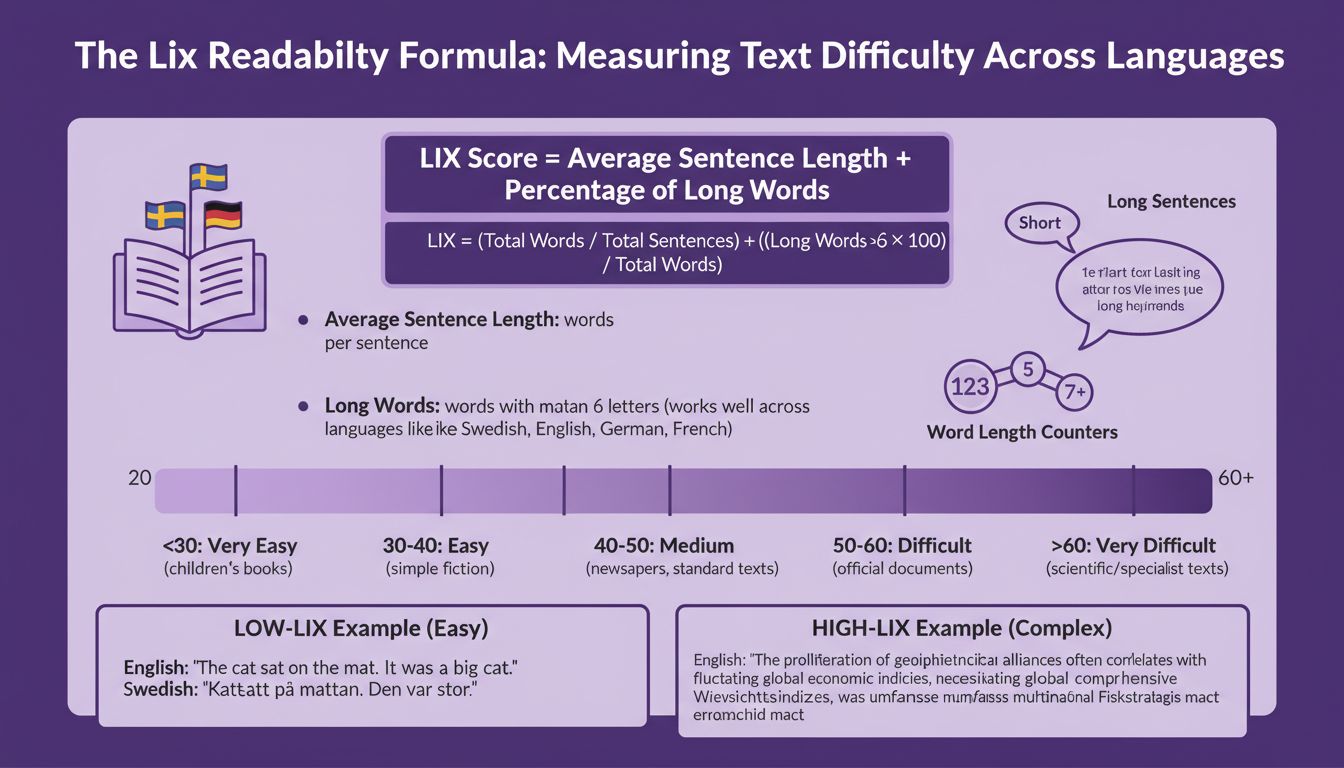
- Word Factor: The percentage of long words (words with more than 6 letters)
- Sentence Factor: The average number of words per sentence
The formula is:
By using word length instead of syllables, Lix becomes more objective and faster to calculate. It also works better across different languages, since syllable counting can vary significantly between languages.
Testing Lix Across Languages
To validate Lix's effectiveness across languages, researchers at Flinders University conducted an independent study comparing French and English texts. They selected 10 fiction books used in upper primary and lower secondary schools, choosing books that had translations available in both languages.
The researchers calculated Lix scores for parallel text samples in both French and English, using Björnsson's recommended method of analyzing 2,000-word samples. They also applied the Flesch Reading Ease formula to the same texts for comparison.
The results were promising: Lix scores in French correlated 0.87 with Lix scores in English, suggesting that the formula measures similar difficulty factors across both languages. When compared to Flesch scores, Lix showed strong correlations (-0.80 for French, -0.78 for English), indicating that Lix provides valid measures of text difficulty comparable to established English formulas.
How to Calculate Lix: Step-by-Step
Calculating Lix is straightforward. Here's how to do it:
- Count the total number of words in your text sample
- Count the number of long words (words with more than 6 letters)
- Count the number of sentences
- Calculate word length: Divide long words by total words, then multiply by 100
- Calculate sentence length: Divide total words by number of sentences
- Add the two values and round to the nearest whole number
Let's look at an example. Consider this complex legal text:
"Where the amount of the annuity derived by the taxpayer during a year of income is more than, or less than, the amount payable for a whole year, the amount to be excluded from the amount so derived is the amount which bears to the amount which, but for this sub-section, would be the amount to be so excluded the same proportion as the amount so derived bears to the amount payable for the whole year."
This text has 76 words, 11 long words (over 6 letters), and 1 sentence. The calculation would be:
- Word length: (11 ÷ 76) × 100 = 14.5%
- Sentence length: 76 ÷ 1 = 76 words
- Lix score: 14.5 + 76 = 90.5 (rounded to 91)
Now compare this to a simpler text:
"I went to sleep with gum in my mouth and now there's gum in my hair and when I got out of bed this morning I tripped on my skateboard and by mistake I dropped my sweater in the sink while the water was running and I could tell it was going to be a terrible, horrible, no good, very bad day."
This text has 68 words, 11 long words, and 2 sentences:
- Word length: (11 ÷ 68) × 100 = 16.2%
- Sentence length: 68 ÷ 2 = 34 words
- Lix score: 16.2 + 34 = 50.2 (rounded to 50)
Notice how sentence length contributes more to the total score in both examples. In the first text, sentence length accounts for 84% of the Lix score, while in the second, it's 68%.
Interpreting Lix Scores
Björnsson created interpretation guidelines for Swedish texts. While these norms were developed for Swedish, research suggests they work reasonably well for other languages too, including English, French, German, and Greek.
20-25: Very Easy
Suitable for young children's materials and beginner-level content. Simple vocabulary and short sentences.
30-35: Easy
Appropriate for general web content, blog posts, and materials for middle school readers.
40-45: Medium
Standard difficulty for most adult readers. Good for news articles and general interest content.
50-55: Difficult
Requires higher education or specialized knowledge. Appropriate for technical documentation or academic content.
60+: Very Difficult
College-level or graduate-level material. Only suitable for highly educated or specialized audiences.
Note: These interpretation guidelines were developed for Swedish texts. While research shows Lix works across languages, interpretation may vary slightly depending on the language.
Why Lix Matters in a Globalized World
As our world becomes more interconnected, the need for multilingual readability tools grows. Consider these statistics:
- Over 50% of the world's population reads online content in multiple languages
- In the European Union, over 80% of upper secondary students study at least two foreign languages
- Bilingual and multilingual populations are growing rapidly worldwide
Yet most readability research continues to focus on English. This creates a problem: content creators working in other languages, or creating multilingual content, lack reliable tools to assess text difficulty.
Lix offers a solution. By using word length and sentence length—features that work across languages—Lix provides a practical tool for assessing readability in multiple languages without needing language-specific syllable rules or word lists.
Advantages of Lix for Multilingual Content
Lix offers several key advantages for those working with foreign language or multilingual content:
- Language Independence: Works across languages without requiring language-specific adaptations
- Objective Measurement: Uses word length (letter count) rather than subjective syllable counting
- Quick Calculation: Faster to compute than formulas requiring syllable analysis
- Validated Across Languages: Research shows it correlates well with other readability measures in multiple languages
Limitations and Considerations
Like all readability formulas, Lix has limitations. It provides an estimate of text difficulty, but doesn't account for:
- Reader factors: Individual background knowledge, motivation, or reading skills
- Content purpose: Why the text was written and how readers will use it
- Text interaction: How readers engage with the material
- Cultural context: Idioms, cultural references, or local expressions that affect comprehension
Additionally, while Lix works across languages, the interpretation scales were developed for Swedish. Content creators should use Lix as one tool among many, considering their specific audience and context.
The Future of Multilingual Readability
As globalization continues, the need for effective multilingual communication tools becomes more urgent. While Lix represents an important step forward, there's still much work to be done. We need:
- More research on readability across different languages
- Better understanding of how cultural context affects comprehension
- Tools that account for idioms, local expressions, and cultural nuances
- Collaboration between linguists, cognitive scientists, and cultural researchers
Lix shows that it's possible to create readability tools that work across languages. As we continue to build a more connected world, tools like Lix will become increasingly valuable for ensuring content is accessible to diverse, multilingual audiences.
Using Lix in Your Work
Whether you're creating content in multiple languages, working with foreign language materials, or simply want a simple readability measure, Lix offers a practical solution. Our readability checker includes Lix calculations alongside other formulas, giving you a comprehensive view of your text's difficulty.
Remember: readability formulas are tools, not rules. Use Lix to guide your writing, but always consider your specific audience, purpose, and context. The goal isn't to hit a specific number, but to create content that your readers can understand and engage with effectively.