Building on a Strong Foundation
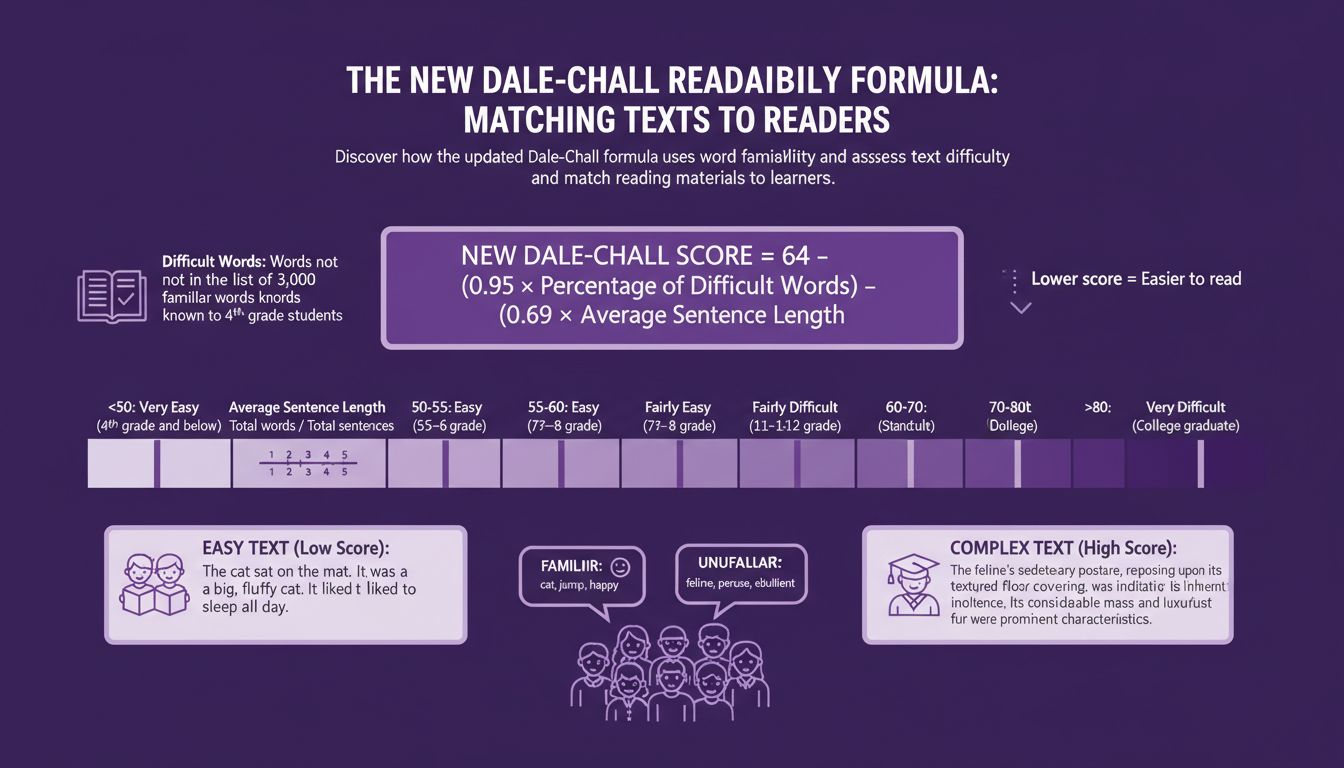
The New Dale-Chall Readability Formula represents a significant improvement in readability scoring, building upon the foundation laid by its predecessor. The original Dale-Chall Readability Formula, developed by Edgar Dale and Jeanne Chall in the 1940s, became a standard tool for scoring text readability. It helped educators and publishers match reading materials to learners' reading abilities, ensuring comprehension and promoting further reading.
While the original formula was useful, focusing on difficult words and average sentence length, it had limitations. It didn't fully capture syntactic complexity and word familiarity in a way that reflected how readers actually process text. The New Dale-Chall formula addresses these shortcomings with improved linguistic and syntactic features, along with an expanded and updated list of familiar words known as the Chall Word List.
How the New Dale-Chall Formula Works
The formula scores text through a systematic process that identifies and measures key readability factors:
- Word Identification: The formula identifies words that are absent from the Chall Word List. These words are considered "difficult words" because readers might find them challenging.
- Difficult Words Count: The number of difficult words is tallied throughout the text.
- Sentence Count: The average sentence length is calculated. Longer average sentences could imply more intricate sentence structures, impacting the text's overall readability. This factor extends the complexity assessment beyond just vocabulary.
- Familiar Words Adjustment: The number of difficult words is divided by the total word count, and the result is multiplied by 100 to give the percentage of difficult words.
The formula is:
Where:
- Unfamiliar Words are defined as 2+ syllable non-sight words (words not on the Chall Word List)
- Total Words is the total number of words in the text
- Sentences is the number of sentences in the text
Understanding the Score
The score shows the "reading ease" of a text, considering both difficult words and sentence length, with more weight given to difficult words. Unlike some formulas, the New Dale-Chall formula doesn't output a number that directly matches a U.S. grade level. Instead, the score scales from high to low, from "reading ease" to "reading difficulty."
Here's how to interpret your score using the Bormuth/Dale-Chall Reading Scale:
| Score Range | Difficulty | Age | Grade |
|---|---|---|---|
| 58+ | Extremely Easy | 5-6 years | 1 |
| 57-54 | Very Easy | 7 years | 2 |
| 53-50 | Fairly Easy | 8 years | 3 |
| 49-45 | Easy | 9 years | 4 |
| 44-40 | Average | 10-11 years | 5-6 |
| 39-34 | Average – Slightly Difficult | 12-13 years | 7-8 |
| 33-28 | Slightly Difficult | 14-15 years | 9-10 |
| 27-22 | Fairly Difficult | 16-17 years | 11-12 |
| 21-16 | Difficult | College Student | 14 |
| 15- | Very Difficult | 18+ | College Graduate |
Understanding Constants, Coefficients, and Measurements
The formula's components aren't arbitrary—they're based on years of research and statistical analysis. Let's break down what each part means and why it matters:
1. The Constant (64)
This is the starting score. If a text has zero unfamiliar words and very short sentences, the score begins at 64, which represents extremely easy text.
Why 64? Jeanne Chall and Edgar Dale wanted the formula to reflect the natural upper limit of readability for basic, familiar writing. They tested thousands of texts across grade levels and found that most very simple texts (like those using only familiar vocabulary) hovered around this score. This constant establishes the baseline for maximum readability.
2. The Coefficients (0.95 and 0.69)
These are the weights that tell the formula how much each factor matters in determining readability.
- 0.95: Applied to the percentage of unfamiliar words. A higher number here means difficult vocabulary lowers the score significantly. This reflects the strong impact that unfamiliar words have on comprehension.
- 0.69: Applied to the average sentence length. Long sentences also reduce readability, but slightly less than unfamiliar vocabulary. This coefficient is lower because sentence length, while important, has a somewhat smaller impact than vocabulary difficulty.
Why these numbers? Chall and Dale ran statistical analyses on how well different features predicted reading difficulty. They discovered that vocabulary difficulty had a stronger impact on comprehension than sentence length. So, they gave unfamiliar words more weight (0.95 vs. 0.69) to reflect this finding.
3. The Measurements
These are what the formula actually analyzes:
- Unfamiliar Words ÷ Total Words × 100: This tells us what percentage of words are likely unfamiliar to the average reader. This percentage is then weighted by 0.95 in the formula.
- Total Words ÷ Sentences: This gives the average sentence length, which is linked to syntactic complexity. These values are pulled directly from the text and change depending on what you're analyzing.
Jeanne Chall and Edgar Dale didn't just guess these numbers—they based them on years of research, classroom testing, and statistical analysis. Their goal was to help educators and writers make sure that reading materials were appropriate for their audience.
Real-World Example: NEW MOON
The New Dale-Chall formula scored "NEW MOON," the 2006 romantic fantasy novel by author Stephenie Meyer, at a 5th-6th reading grade level. This score was validated by teachers and literary specialists, demonstrating the formula's accuracy in assessing text difficulty. The formula correctly identified that while the book uses accessible language and familiar vocabulary, its sentence structure and overall complexity make it appropriate for middle-grade readers.
Applications of the Dale-Chall Formula
The Dale-Chall formula is particularly useful for educators, publishers, and writers who need to choose reading materials that match their audience's reading skills. The formula's standard and unbiased measure of text complexity aids in effective literacy instruction and content development.
Educators use it to:
- Select appropriate textbooks and reading materials for different grade levels
- Match students with books that challenge them appropriately
- Develop curriculum materials that align with learning objectives
Publishers use it to:
- Ensure their materials are appropriate for target age groups
- Maintain consistency across educational series
- Create content that supports literacy development
Writers use it to:
- Adjust their writing style to match their audience
- Identify areas where vocabulary or sentence structure might be too complex
- Create content that's accessible to their target readers
Limitations and Other Factors That Matter
However, like all formulas, the Dale-Chall formula is limited. Text assessment is more than just a numbers-based approach. Here are other important factors that affect readability but aren't captured by the formula:
1. Content Relevance
Text should matter to the reader. Even simple writing may confuse if it discusses unfamiliar or dull topics. Conversely, a complex topic can grip a reader if it speaks to their interests. A reader passionate about a subject will work harder to understand difficult content.
2. Reader Motivation
The reader's eagerness to learn affects understanding. An excited reader will try harder to grasp tough content. Engaging and inspiring text is crucial, regardless of its readability score.
3. Learning Styles
Everyone absorbs information differently. Some lean towards images, others prefer words or sounds. These preferences play a part in judging a text's complexity and accessibility.
4. Background Knowledge
Familiarity with the subject shapes the reader's grasp of the text. Unknown terms or concepts can stump them, no matter how readable the text is according to the formula. A medical text might score well but still be incomprehensible to someone without medical training.
5. Cultural References
Texts often use idioms or references known only to certain cultures. These can hinder understanding for others, even if the words themselves are familiar.
6. Text Structure
The layout of a text affects its readability. Clear headings, bullet points, diagrams, and logical flow can aid comprehension, even when the vocabulary and sentence structure are complex.
7. Language Nuances
Tricky language devices like irony, sarcasm, or metaphor can make comprehension harder. These aren't covered by readability formulas but can significantly influence understanding.
Using Readability Tools Wisely
While readability tools like the Dale-Chall formula can be useful, writers still need to review the overall text's complexity and the target audience's needs. The formula provides valuable guidance, but it should be one tool among many in your writing toolkit.
Consider your readers' background knowledge, interests, and motivation. Think about how the content is structured and presented. Remember that even a "difficult" text can be accessible if it's well-organized, engaging, and relevant to your audience.
Getting Started with Dale-Chall
Ready to assess your text's readability? Our readability scoring system allows you to score your text using both the original and updated versions of the Dale-Chall formula, or select from a range of syntactic, word-based, and graph-based formulas. This gives you multiple perspectives on your text's difficulty, helping you create content that truly matches your readers' needs.
Remember: the goal isn't to achieve a specific score, but to understand your text's complexity and ensure it's appropriate for your intended audience. Use the Dale-Chall formula as a guide, but always consider the full picture of what makes text readable and accessible.