The Pioneer of Readability Measurement
The Flesch Reading Ease (FRE) formula stands as one of the original readability formulas, still widely used today by writers, editors, and content creators. Developed in 1948 by Rudolph Flesch, this formula has become a cornerstone of readability measurement.
Rudolph Flesch was an Austrian-born author, writing consultant, and passionate advocate for the Plain English Movement. After studying law in Austria, he moved to the United States and earned a Ph.D. in English from Columbia University. Throughout his career, Flesch championed clear, accessible writing and was a strong supporter of phonics-based reading instruction.
In his groundbreaking 1948 article "A New Readability Yardstick," published in the Journal of Applied Psychology, Flesch introduced the world to his readability formula. This formula would go on to influence how we measure and improve text clarity for decades.
How the Formula Works
The Flesch Reading Ease formula uses two key measurements to assess text difficulty:
- Syllables per word: Measures vocabulary complexity
- Words per sentence: Measures sentence structure and length
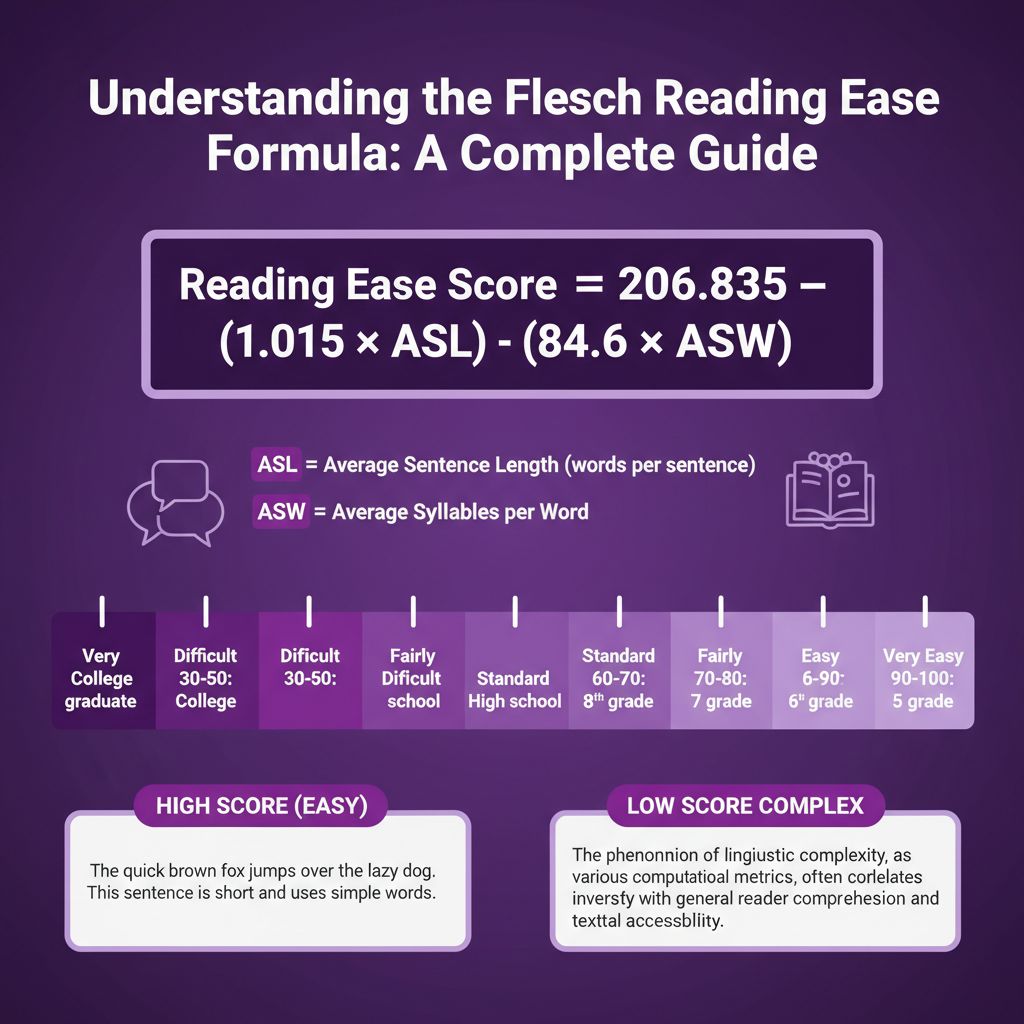
The formula calculates a score from 0 to 100, where higher scores indicate simpler, more readable text. Here's the mathematical formula:
Let's break down what each component means:
- 206.835: This constant serves as a baseline score, establishing the starting point for calculating readability
- 1.015: This coefficient determines how much average sentence length impacts the final readability score
- 84.6: This coefficient weighs the impact of word complexity—specifically, the number of syllables per word—on the readability score
The Logic Behind the Formula
Flesch's formula is based on two core principles about how people read:
Word Complexity Matters
Flesch believed that shorter words with fewer syllables are easier to read and understand than longer, more complex words. The formula treats words with 1-2 syllables as easy to read, while words with 3 or more syllables are considered more challenging. This makes intuitive sense: "cat" is easier to process than "catastrophe."
Sentence Length Affects Comprehension
Flesch also believed that shorter sentences help readers digest information more quickly and easily. When sentences are too long, readers must hold multiple ideas in their working memory, making comprehension more difficult. Therefore, texts with shorter sentences receive higher readability scores.
Understanding Your FRE Score
The final score falls on a scale of 0 to 100, where higher scores indicate greater readability. A text scoring 90-100 is considered very easy to read, while a score below 30 suggests challenging, academic-level material. Here's the complete reading level chart:
90-100: Very Easy
Extremely simple text, like children's books or basic instructions. Suitable for elementary school readers.
80-89: Easy
Simple, conversational text. Great for general web content and consumer materials. Appropriate for middle school readers.
70-79: Fairly Easy
Readable for most adults. Suitable for news articles and general interest content. 7th-grade reading level.
60-69: Standard
The ideal range for most web content. Understandable by 8th-9th graders and the general public. This is the sweet spot for maximum engagement.
50-59: Fairly Difficult
Requires some education or background knowledge. Appropriate for technical content or professional articles. 10th-12th grade level.
30-49: Difficult
College-level material. May lose general readers but appropriate for specialized or educated audiences.
0-29: Very Confusing
Graduate-level or highly technical material. Only suitable for experts in the field.
Real-World Example: When Scores Don't Tell the Whole Story
It's important to remember that readability scores measure text structure, not content complexity. Consider "It Ends with Us," an award-winning romance novel by Colleen Hoover. The Flesch Reading Ease formula correctly scored it at a 6th-grade reading level based on its accessible writing style, straightforward vocabulary, and conversational dialogue.
However, despite the simple language, most teachers and librarians recommend this book for college and adult readers due to its complex and emotionally intense subject matter. This illustrates an important point: readability formulas measure how easy the text is to decode, not how appropriate the content is for a particular age group.
Limitations of the Flesch Reading Ease Formula
While the FRE formula is valuable and widely used, it has some important limitations:
- Focuses on surface features: The formula primarily looks at word and sentence length, missing other key factors like sentence structure complexity, word variety, and overall clarity of expression.
- Lacks context awareness: The formula doesn't account for reader-specific context. A text full of technical jargon might score high if the words are short, even though it would be difficult for the average reader.
- One-dimensional measurement: Readability involves many factors beyond word and sentence length. The formula might miss elements like logical flow, coherence, or the use of examples and illustrations that affect comprehension.
Despite these limitations, the formula's simplicity and accuracy have made it popular across many writing disciplines.
Applications Across Industries
The Flesch Reading Ease formula is used in diverse fields to ensure content matches audience needs:
Education
Educators and publishers use the formula to verify that textbooks suit different grade levels. Matching reading level with students' abilities improves learning and comprehension. In curriculum development, the formula helps prepare grade-appropriate reading materials, creating a balanced learning experience.
Journalism
Journalists and editors use the formula to ensure news articles are readable, reaching broader audiences effectively. In the digital realm, online journalists use it to make web articles reader-friendly, increasing engagement and time on page.
Technical Writing
Technical writers use the formula to create user manuals that are easy to understand, improving user experiences and reducing support requests. In safety-critical industries, the formula helps craft clear safety instructions to avoid accidents and misunderstandings.
Legal and Business
Legal professionals use it to assess contract readability, ensuring clear terms and conditions for all parties. Companies use it to draft user-friendly privacy policies and terms of service, fostering trust and compliance.
Healthcare
In healthcare, the formula helps create easy-to-read patient information leaflets and health materials, ensuring patients can understand important medical information.
Government
Government agencies use the formula to write clear public communications that are accessible to citizens from diverse backgrounds and literacy levels, promoting transparency and civic engagement.
Getting Started with Flesch Reading Ease
Ready to check your text's readability? Our readability scoring system calculates both the Flesch Reading Ease score and the Flesch-Kincaid Grade Level, giving you comprehensive insights into your content's difficulty. Whether you're writing for students, professionals, or the general public, understanding your FRE score helps you create content that truly connects with your audience.
Remember: use readability scores as a guide, not a strict rule. The goal is to match your content's difficulty to your audience's needs, creating clear, accessible communication that serves your readers well.